[Headlines (3 Options)]
[Hook & Introduction]
Alright fellas — let me ask you something real quick.
How many guys do you know who are on Ozempic, Wegovy, or Mounjaro right now?
A few? A lot?
Because there are over 15 million Americans on GLP-1 weight-loss drugs — and that number is growing fast.
And most of them — most of US — have no idea about what might be happening inside our muscles.
Not the fat. The MUSCLE.
Because here's the thing nobody's talking about in the weight-loss conversation —
Scientists at UC Irvine just published a study in Nature Metabolism.
And what they found should change the way every man thinks about his body while on these drugs.
There is a TIMED metabolic switch inside your muscle cells.
It's a precise biological sequence that has to happen in the right order for muscle to rebuild.
And GLP-1 medications — the drugs millions are using right now — may be disrupting that sequence.
Not maybe ruining it. Potentially FLIPPING IT OFF before it can finish.
This is the muscle loss angle. The one nobody's talking about.
And fellas — today we're talking about it.
[Why It Matters]
Here's the stat that should wake everybody up.
According to a review published in The Lancet, studies show that muscle loss with GLP-1 medications can account for anywhere from 25% to 39% of the TOTAL weight lost.
Read that again.
If you lose 50 pounds on Ozempic — up to 20 of those pounds could be MUSCLE.
Not fat. MUSCLE.
And UC Davis Health reports the number can be even worse — some patients experience 15 to 25% lean muscle mass loss during rapid GLP-1-driven weight reduction.
Now here's why the UC Irvine discovery matters so much.
We finally have a BIOLOGICAL EXPLANATION for WHY this is happening at the cellular level.
It's not just "you're eating less protein" or "your body is in a deficit."
It goes DEEPER than that.
It's about a metabolic timer inside your muscle stem cells — and what happens when that timer gets disrupted.
[5 Conversation Starters]
1. YOUR MUSCLES HAVE A BUILT-IN REPAIR SEQUENCE — AND IT'S MORE LIKE A COMPUTER PROGRAM THAN A LIGHT SWITCH.
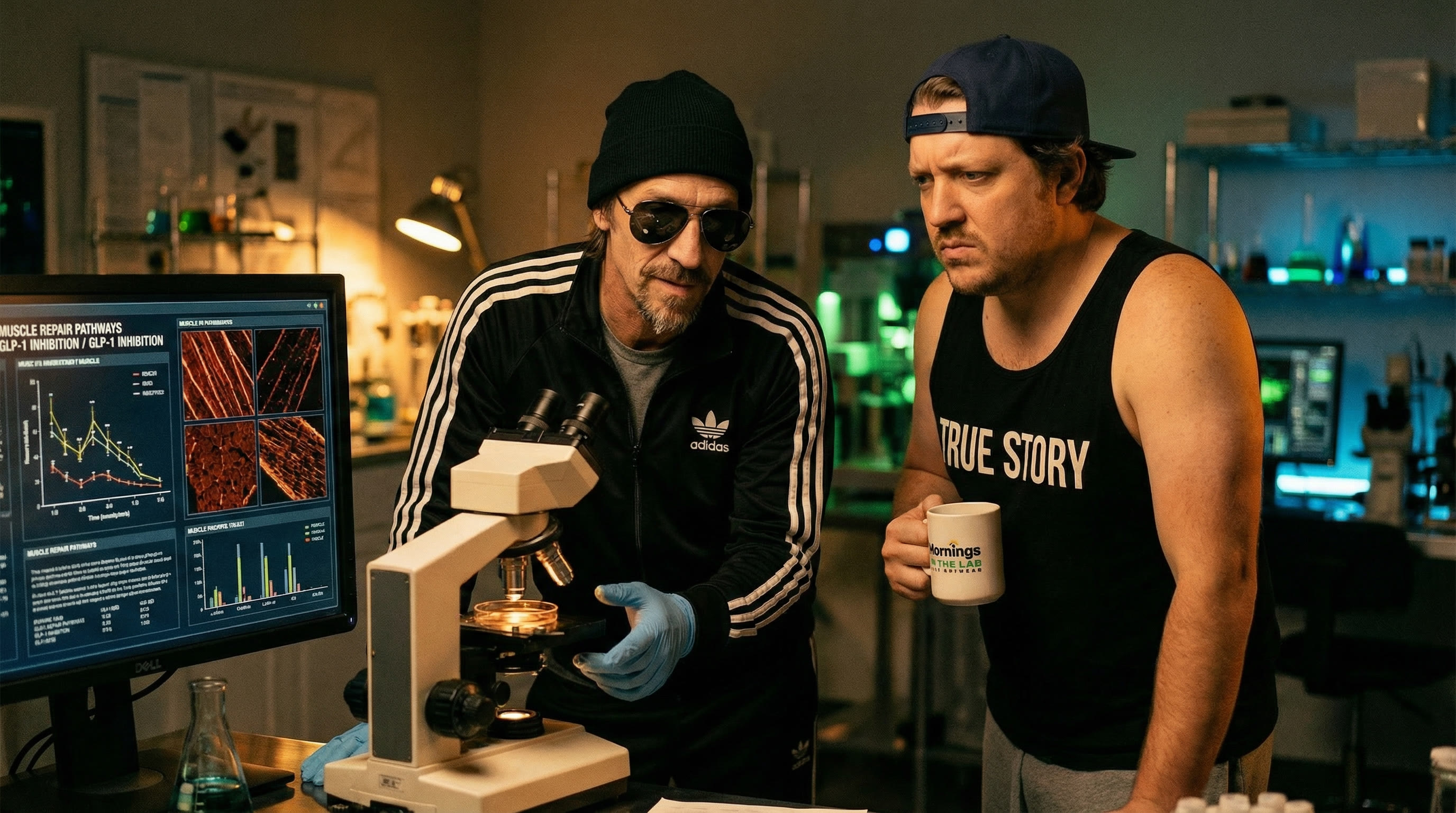
According to the UC Irvine study published in Nature Metabolism in February 2026, when muscle sustains stress or damage, stem cells don't immediately go into "build mode."
They first SLOW DOWN energy production.
They reroute glucose away from burning it for fuel — and redirect it into PROTECTIVE repair work.
Making antioxidants. Reducing inflammation. Stabilizing the damage.
THEN — once that phase is complete — the switch flips again, energy production ramps back up, and muscle fibers form and grow stronger.
Two distinct phases. In a precise sequence. And BOTH have to happen correctly.
2. THE ENZYME AT THE CENTER OF ALL THIS IS CALLED PFKM — AND MOST PEOPLE HAVE NEVER HEARD OF IT.
PFKM is a muscle-specific enzyme that controls how your cells process glucose.
Lead researcher Dr. Lauren Albrecht — UC Irvine assistant professor of pharmaceutical sciences — and her team discovered something surprising.
PFKM levels are DELIBERATELY kept low in muscle stem cells during that first repair phase.
That's intentional. The body is saying: "Not yet. We're not growing yet. We're fixing first."
When PFKM returns, that's the green light. Muscle building begins.
According to UC Irvine News, those fuel changes can happen within MINUTES of muscle stress.
This is a finely tuned system that evolution has been perfecting for millions of years.
3. WHEN YOU DISRUPT THE PFKM TIMER, THE MUSCLE DOESN'T FULLY RECOVER.
The UC Irvine team tested what happens when PFKM is knocked down — when that transition from repair to growth is blocked.
The result? Significantly fewer mature muscle fibers formed.
The cells got stuck in repair mode. They couldn't complete the switch to growth.
According to the study in Nature Metabolism, PFKM-depleted cells showed reduced numbers of muscle-forming nuclei and lower levels of myosin — the protein that makes muscles actually CONTRACT and generate force.
Less myosin. Less force. Weaker muscles.
That's not a theory. That's what they measured in human muscle cell lines.
4. THE GOOD NEWS — THIS TIMER CAN BE INFLUENCED FROM THE OUTSIDE.
Here's where it gets exciting.
Dr. Albrecht and her team didn't just identify the problem — they found a way to work around it.
By supplying specific downstream metabolic building blocks — nutrients that the cells would naturally produce LATER in recovery — they were able to ACCELERATE the transition from repair mode to growth mode.
In other words: you can potentially help the switch flip faster and more completely.
According to UC Irvine's Biological Sciences department, when PFKM was reduced, supplementing with a specific glycolytic metabolite called 3-phosphoglycerate restored muscle cell differentiation.
This is the beginning of a roadmap for protecting muscle during GLP-1 therapy.
5. THE GLP-1 CONNECTION ISN'T HYPOTHETICAL — DOCTORS ARE SEEING IT IN PATIENTS RIGHT NOW.
Dr. Albrecht stated directly: "With the rapid rise of GLP-1 therapies and an aging population, preserving muscle mass has become a major health priority."
And a 2024 systematic review on PubMed analyzing six studies with over 1,500 adults found notable lean mass reductions — ranging from near 0% to 40% of total weight lost — in patients on semaglutide.
The research community is now urgently trying to understand WHY and HOW MUCH.
Science Direct reported in 2025 that GLP-1 receptor agonist use is characterized by muscle mass loss ranging from 20% to 50% of total weight lost in different studies.
Fifty percent. Some guys are losing more muscle than fat.
[Context & Key Insights]
Let's go deeper on what's actually happening here.
The study was led by Dr. Lauren Albrecht at UC Irvine's School of Pharmacy & Pharmaceutical Sciences.
First author is Melissa Campos, a PhD student in the Albrecht lab.
They collaborated with researchers from UCLA and Yale University.
The work was funded by the National Institutes of Health — the National Institute of General Medical Sciences, the National Institute of Arthritis and Musculoskeletal and Skin Diseases, and the National Cancer Institute — plus the Alfred P. Sloan Foundation.
This isn't some fringe lab. This is serious, well-funded, peer-reviewed research published in one of the world's top journals.
Now — here's the frame I want you to hold in your mind.
Think of your muscles like a construction crew after a natural disaster.
First, they don't build new stuff. They clear debris. They shore up what's still standing. They make the site SAFE.
Only after that is done do they start laying new foundations.
PFKM is the signal that says: "Construction crew — the site is safe. Start building."
GLP-1 drugs, combined with rapid caloric restriction, may be interfering with that signal.
The cells are getting confused. The timer is off.
And here's the brutal reality — muscles you lose during rapid weight loss are HARD to get back.
The older you are, the harder it is. Especially for men over 40.
That's called sarcopenia — age-related muscle loss — and GLP-1-driven muscle wasting can accelerate it.
But Dr. Albrecht also gave us reason for optimism.
"Our work identifies a metabolic checkpoint that could one day be targeted to help people recover muscle more effectively."
That's the door this research opens.
And for the fitness-focused guys in this community — the guys who've worked YEARS to build their body — this is the science that could protect what you've built.
[Practical Takeaway]
So what do you actually DO with this?
Here's where we land, fellas.
FIRST — if you are on a GLP-1 drug or considering one, have a direct conversation with your doctor about muscle preservation.
Not just "will I lose weight." Ask specifically: "What is your protocol to protect my lean mass?"
SECOND — resistance training is your best defense right now.
According to the ECO 2025 study presented at the European Congress on Obesity, patients who combined GLP-1 therapy with regular resistance training showed significantly better muscle retention.
LIFT. It's not optional if you're on these drugs.
THIRD — protein intake matters MORE, not less, when you're in a caloric deficit on GLP-1s.
UC Davis Health's exercise physiologist Dr. Keith Baar, professor of Neurobiology, Physiology and Behavior, said directly: "It is still important for patients taking GLP-1 medication to limit muscle wasting through exercise and high-quality protein."
FOURTH — watch this space.
The UC Irvine team has identified a specific metabolic target — the PFKM pathway — that could be used to develop interventions to protect muscle during GLP-1 therapy.
There may be a supplement or pharmaceutical solution coming that targets this exact mechanism.
Stay informed. The science is moving FAST.
[Audience Reflection]
Here's the question I want you to sit with today.
If you found out that a drug — or any rapid weight-loss approach — was costing you 20 to 39 percent of your muscle mass along with the fat...
Would that change your approach?
Would you still do it the same way?
Because the goal isn't just a smaller number on the scale.
The goal is a STRONGER, healthier version of you.
Muscle isn't just aesthetics. Muscle is metabolic health. Muscle is longevity. Muscle is quality of life at 60, 70, 80 years old.
So what does REAL transformation look like for you — and are you protecting the thing that matters most while you chase it?
[Community Engagement]
Fellas — I want to hear from this community today.
Are you on a GLP-1 drug? Have you noticed changes in your strength or muscle mass?
Or are you someone who's been watching the Ozempic era unfold and thinking about the long game?
Drop it in the comments. Real talk, no judgment.
This is exactly the kind of conversation we need to be having — because most people aren't having it.
And if this hit different for you — if this is the thing that made you stop and think — share this show with somebody who needs to hear it.
Your gym partner. Your buddy who just started Wegovy. Your dad who's thinking about it.
This is why we're here. Real information. Real conversations. Every single morning.
[Empowering Close]
Here's what I want you to walk away with today.
Your body is REMARKABLE.
The fact that your muscle cells have this precise, timed, multi-phase repair system — that evolved over millions of years — is genuinely incredible.
And now we understand it better than we ever have before.
That knowledge is POWER.
Whether you're on GLP-1 drugs, considering them, or you're a natural lifter who will never touch them —
Understanding how your muscles actually rebuild makes you a better athlete, a better patient, a better advocate for your own health.
Dr. Albrecht said it best: "Muscle metabolism isn't simply about fueling growth — it's about strategic recovery."
Strategic. That's the word.
Be strategic about your body. Be strategic about your health decisions.
And start every morning with the information you need to make those decisions right.
That's what we do here. That's Morning Intel for Men.
Let's have a great Thursday, fellas. March 19th, 2026.
Show 3007. Season 3, Episode 7.
I'm here with you. Let's go.
[Keyword Integration]
This is your live morning show — daily morning motivation built for men who want more than headlines.
We have real men's conversations here. Real talk, backed by science, delivered every morning.
We're your daily accountability partner — start your day right, men.
This is the informative conversation and the entertaining conversation you didn't know you needed.
Fitness. Healthy lifestyle. Technology. Business. AI. Science that affects YOUR life.
We bring it all together right here.
This is bapl. This is Morning Intel for Men.
Show 3007 in the books. See you tomorrow.