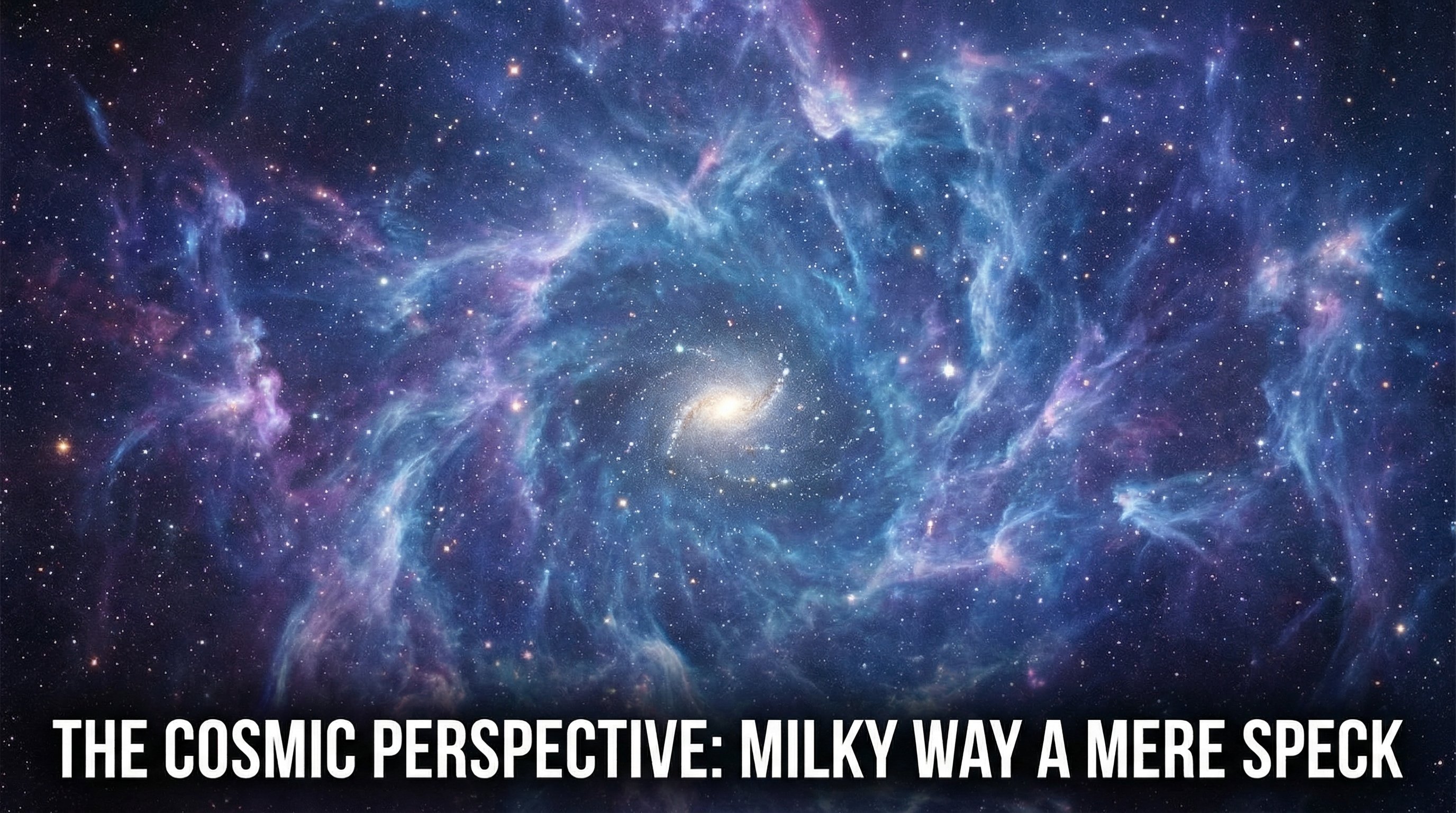
Imagine looking up at the night sky, feeling like the universe revolves around us, and then—bam—science reminds you we're just a speck on a cosmic pancake. Astronomers have discovered that the Milky Way isn't floating solo in space; it's embedded in a massive, flat sheet of dark matter stretching tens of millions of light-years across, like our galaxy is chilling in the middle of an enormous, invisible bedsheet.Phys.org
This wild revelation comes from a team led by PhD grad Ewoud Wempe and Professor Amina Helmi at the University of Groningen, working with collaborators from Germany, France, and Sweden. They didn't spot it with a telescope—Mauna Kea vibes aside, though Hawaii's observatories have crushed other Milky Way feats. Instead, they ran super-advanced computer simulations, starting from the early universe's mass setup based on cosmic microwave background data. These sims evolved over billions of years to create 'virtual twins' of our Local Group: the Milky Way, Andromeda, and 31 nearby galaxies, matching their exact masses, positions, and speeds.ScienceDaily
What popped out? The matter around us—ordinary stuff plus the mysterious dark matter that outweighs visible stars—isn't in a nice spherical halo like we thought. Nope, it's flattened into a vast plane, with huge empty voids above and below. This setup perfectly explains a head-scratcher that's bugged astronomers for decades: why do nearly all nearby galaxies zip away from us, following the universe's expansion like good little Hubble citizens, instead of getting yanked in by the Local Group's gravity? Andromeda's the lone rebel heading our way for a future smash-up, but everyone else? Peace out. The sheet's distant mass counteracts our pull for galaxies in the plane, and the voids are galaxy-free, so no incoming traffic to spot.Nature Astronomy
The paper dropped in Nature Astronomy earlier this year, and it's a game-changer because it fits snugly into our standard cosmology without tossing out dark matter or anything drastic. Wempe called it thrilling: 'We now have a model consistent with the current cosmological model... and our local environment.' Helmi was pumped too: 'Based purely on galaxy motions, we can determine a mass distribution that matches what we see.'Phys.org
Why should you care on your morning coffee run? This isn't just nerd trivia—it's a peek into the cosmic web, that giant scaffolding of sheets, filaments, and voids shaping the universe. Our 'tiny' Milky Way, already 100,000 light-years wide with 200 billion stars, turns out to be part of something 300 times bigger in span. It solves why our neighborhood feels weirdly calm amid cosmic chaos, and hints at how dark matter—85% of all matter—really organizes on huge scales. Future telescopes might map this sheet directly, refining our big bang story and galaxy evolution models. We thought we were special; turns out we're just along for the ride in the universe's grand, flat design.
Here's the Mornings take: Doesn't this make you feel both insignificant and invited to the party? Like, the universe baked us into this pancake, dark matter frosting and all. Next time you're stargazing, picture our galaxy surfing that sheet—makes Andromeda's crash course feel like a blind date with destiny. Science keeps humble-bragging on our place in the cosmos, and honestly, it's the best wake-up call ever. Pass the creamer.