---
[Hook & Introduction]
Fellas — yesterday, human beings did something that has NEVER been done before in the history of the species.
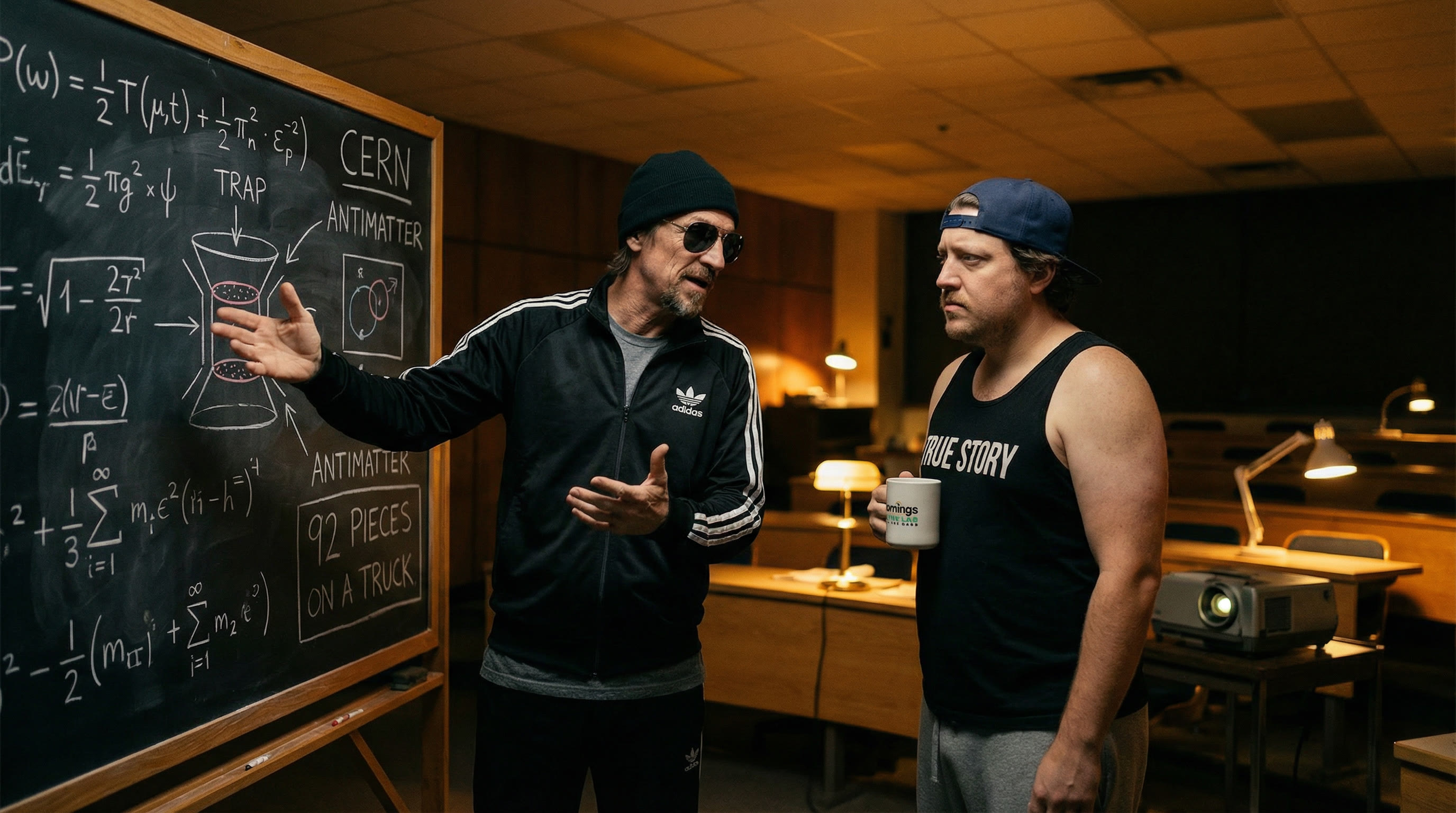
Scientists at CERN — the most advanced particle physics lab on the planet — loaded 92 pieces of ANTIMATTER onto the back of a truck.
Not a metaphor. Not a simulation. A TRUCK.
They drove it around campus. Staff lined up with their PHONE CAMERAS to watch.
And when it was over, they popped a bottle of CHAMPAGNE.
According to Nature, this happened on March 24th, 2026 — yesterday — at CERN's facility outside Geneva, Switzerland.
And I know what you're thinking — "Peter, antimatter… isn't that the stuff that BLOWS UP when it touches regular matter?"
YES. That is EXACTLY what it is.
And they drove it down the road.
This is the kind of story that makes you feel like you're living in the future — so let's GET INTO IT.
---
[Why It Matters]
Here is what makes this absolutely MIND-BENDING.
They transported 92 antiprotons.
According to the AP, the mass of those 92 antiprotons is slightly LESS than the mass of 100 hydrogen atoms.
Let me put that in perspective for you.
A single grain of salt — one grain of salt — contains 10 to the power of 18 particles.
That's a ONE followed by EIGHTEEN ZEROS.
One billion times one billion particles.
In that truck? ONE HUNDRED. Give or take.
And if any single one of those antiprotons touched the wall of the container — touched ANYTHING made of regular matter — it would ANNIHILATE.
It would convert to pure energy in a flash.
That is not science fiction. That is the law of physics.
The AP reports that even if that happened, the energy release would be so small only an oscilloscope — a device that measures electrical signals — could detect it.
But that's not the point.
The point is: humanity just drove antimatter down a road. For the first time. Ever.
Stefan Ulmer, the physicist from Heinrich Heine University Düsseldorf who led the run, said it plainly — and I quote:
"It is something humanity has never done before. It is historic."
---
[5 Conversation Starters]
Number ONE.
The trap they used weighs 850 kilograms — that's nearly 2,200 pounds.
It uses superconducting magnets cooled to NEGATIVE 269 degrees Celsius.
That is negative 452 Fahrenheit.
For reference, that is just ONE DEGREE above absolute zero — the coldest temperature physically possible in the universe.
According to the Nature report on the experiment, the magnets keep the antiprotons suspended in a vacuum — floating — never touching the walls.
Because the walls are made of matter. And matter would kill them instantly.
Number TWO.
This was not CERN's first test — but it's the first time they used ACTUAL antimatter.
According to CERN Courier, about two years ago they loaded roughly 70 PROTONS — regular protons, not anti — into the same trap and drove those around campus as a test run.
That worked. So they knew the trap held up.
March 24th, 2026 — they switched the polarity of the electrodes, loaded ANTIPROTONS, and actually did it for real.
Number THREE.
Here's the big ENGINEERING PROBLEM they still have to solve.
The drive from CERN to the Heinrich Heine University in Düsseldorf, Germany — where they want to deliver antiprotons for precision experiments — is about EIGHT HOURS.
According to the AP, the trap can only run on its own for about FOUR HOURS.
That's TWICE the limit. They drove 8 kilometers yesterday. Düsseldorf is 800 kilometers.
They have to figure out how to keep this thing running continuously on the road — basically building a mobile power plant to go with it.
That university facility isn't even planned to be ready until 2029 at the earliest.
Number FOUR.
WHY do they want to study antimatter outside of CERN?
According to Stefan Ulmer — and I'm quoting the AP here — "We can measure 100 to 1,000 times better outside of this accelerator facility."
CERN itself creates magnetic interference. The giant machines that produce the antimatter also mess with the experiments trying to STUDY it.
Taking antimatter to a quiet lab — no giant accelerators humming — means scientists can measure it with FAR more precision.
That precision is what could reveal whether matter and antimatter behave DIFFERENTLY — which is one of the biggest unsolved questions in physics.
Number FIVE.
Why does any of this matter to YOU?
Tara Shears, an experimental particle physicist at the University of Liverpool, put it perfectly — and I'm quoting directly:
"Antimatter is one of the biggest mysteries that we have in science."
"We haven't been able to study it very much. But it holds the keys to our understanding of what — literally — why the universe is like it is."
Think about that. We still don't fully know WHY the universe exists the way it does.
Antimatter research is one of the paths that might answer that question.
---
[Context & Key Insights]
Let me give you the deeper science here — because this stuff is WILD.
When matter and antimatter meet, they annihilate each other completely.
That's not like a bomb — a bomb converts a tiny fraction of mass into energy.
Antimatter-matter annihilation is 100% efficient conversion of mass into energy.
It is THE most energy-dense reaction physically possible.
Now — here's where it gets really interesting.
According to physics research, when an antiproton annihilates inside uranium or plutonium, it can trigger FISSION.
The same kind of reaction in a nuclear bomb — but triggered by a single antiproton.
That is why some researchers are exploring antimatter for SPACECRAFT PROPULSION.
We're talking about engines that could push spacecraft to a significant fraction of the speed of light.
That's not yesterday's technology — we're talking decades away.
But the research happening RIGHT NOW at CERN is the FOUNDATION of that future.
Here's another thing to appreciate about CERN — they invented the WORLD WIDE WEB.
Tim Berners-Lee, working at CERN in 1989, built the web so scientists could share research data.
The internet as we know it today — born at CERN.
And now they're solving antimatter transport.
The BASE-STEP experiment — that's the name of this project, standing for Baryon Antibaryon Symmetry Experiment — Sympathetic Trapping Experiment in Portable mode — has been working on this for YEARS.
According to the ERC — the European Research Council — project leader Christian Smorra called yesterday "a remarkable achievement, given that antimatter is very difficult to preserve and it annihilates upon contact with matter."
When the trap is stationary and connected to full power, it can store antiprotons for up to TWO WEEKS with no losses.
On battery power alone — like in a truck — only FOUR HOURS.
That's the engineering challenge they're racing to solve before 2029.
---
[Practical Takeaway]
So what does this ACTUALLY mean for real life — for YOU?
In the short term — better physics measurements.
Scientists comparing matter and antimatter at 100 to 1,000 times greater precision could find differences that explain why the universe is made of matter at all.
Because here's the thing — according to our best physics models, the Big Bang should have produced EQUAL amounts of matter and antimatter.
They should have annihilated each other completely.
Nothing should exist.
But HERE WE ARE.
The fact that we — and everything around us — exist is a MYSTERY that antimatter research is trying to solve.
In the medium term — medical applications.
Antiproton-based cancer treatments are already being researched. The precision with which antiprotons deposit energy in tissue could make them more targeted than current radiation therapy.
And in the LONG term — spacecraft propulsion.
The math is incredible. A tiny amount of antimatter could fuel a mission to another star system.
Yesterday's truck ride around a Swiss campus is Step One of a very long journey.
But every revolution starts somewhere.
The Wright Brothers' first flight lasted 12 seconds. Yesterday's antimatter drive lasted 30 minutes.
History was made either way.
---
[Audience Reflection]
Here's what I want you to sit with this morning.
CERN produces antiprotons — the only place on EARTH that does — using a machine called the Antiproton Decelerator.
They fire a proton beam into a metal block.
Some of the collisions produce antiprotons.
They slow them down, trap them, and study them.
The entire GLOBAL supply of trapped, usable antimatter at any given moment?
Is at one facility. In Switzerland.
And yesterday, for the first time, they moved some of it.
So here's my question for you, fellas —
What does it say about humanity that we went from not knowing antimatter existed — to producing it — to DRIVING IT AROUND — all within the last hundred years?
And what will the NEXT hundred years look like?
Drop that in the comments. I want to hear your take.
---
[Community Engagement]
Fellas — if this story hit different this morning, do me a favor.
SHARE this with someone who needs to start their day with something that makes them feel like the future is REAL.
Because it is.
Drop a comment — what blew your mind more: the fact that they DROVE ANTIMATTER, or the fact that CERN is the same place that gave us the internet?
Two world-changing technologies. One lab. In Switzerland.
That's worth a conversation.
And if you're new here — welcome to Mornings in the Lab. We do THIS every single morning.
Real science. Real talk. Real conversation. No fluff.
Hit that follow button so you never miss a morning.
---
[Empowering Close]
Here's what I want you to carry with you today.
Yesterday, a team of scientists did something that had NEVER been done in the history of the human race.
They planned it. They built the technology. They tested it. They failed a few times. They came back.
And then they drove down the road with the most exotic material in the known universe strapped to a truck.
And they popped Champagne.
THAT is what dedication looks like.
That is what happens when you refuse to accept that something is impossible just because it hasn't been done yet.
Whatever YOU are working on right now — whatever goal feels too big, too far away, too hard —
Remember: somebody built a trap for particles that don't even want to exist in this universe.
And then they DROVE IT.
If they can do that — you can do your thing.
Let's get to work, fellas. Have an INCREDIBLE Wednesday.
I'm Peter. This is Mornings in the Lab. And we'll see you tomorrow.
---
[Keyword Integration]
This is your LIVE MORNING SHOW — Mornings in the Lab — bringing you DAILY MORNING MOTIVATION through INFORMATIVE CONVERSATIONS and ENTERTAINING CONVERSATION every single day.
We are your DAILY ACCOUNTABILITY PARTNER and your MORNING ACCOUNTABILITY PARTNER — here to help you START YOUR DAY RIGHT, MEN.
We cover TECHNOLOGY, BUSINESS, AI, SCIENCE, FITNESS, and HEALTHY LIFESTYLE — because growth doesn't happen in a silo.
MEN'S CONVERSATIONS. REAL TALK. That's BAPL.
This is Show #3011 — Season 3, Episode 11 — Wednesday, March 25, 2026.
MORNINGS IN THE LAB. Let's go.